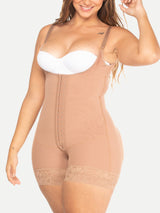
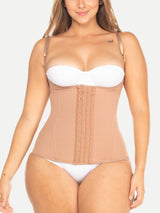









After a tummy tuck, the faja timeline most surgeons follow looks like this: a Stage 1 garment from day one through roughly week two or three, a Stage 2 faja from about week three to week eight once your drains are out, and a Stage 3 faja from month three onward for final contouring. Your first garment is usually chosen by your surgical team. The second one is the one you buy yourself, and it is the one most women get wrong.
In This Article · 8 min read
- What Makes a Tummy Tuck Faja Different
- Weeks 0 to 2: Your First Faja
- Weeks 3 to 8: The Faja You Buy
- Month 3 and Beyond: Stage 3
- Tummy Tuck Faja Timeline at a Glance
- If You Had Lipo 360 With Your Tummy Tuck
- How to Size Your Faja After a Tummy Tuck
- What We See Go Wrong in the Fitting Room
- Frequently Asked Questions
A tummy tuck is not liposuction, and the generic post-op shapewear advice floating around the internet was mostly written for lipo patients. Your incision runs low and wide, hip to hip. If your surgeon repaired your abdominal muscles, there is a suture line doing quiet work underneath it. That changes what your faja has to do and, just as importantly, where it is allowed to press.
We have been fitting Colombian fajas in person at our New Jersey stores since 2012, and a good share of the women who walk in are two or three weeks post-op, holding a garment that is not working for them. Most of what follows comes from those fitting rooms. Your surgeon's instructions always come first, this is a shopping guide, not medical advice.
What Makes a Tummy Tuck Faja Different
Three things, and every recommendation below comes back to them.
- The incision line. It sits low across your abdomen, hip to hip. Any seam, hook column, or elastic band that lands directly on it will rub. Friction on a fresh incision is how you end up with irritation and a wider, more visible scar.
- Your reach. For the first couple of weeks you cannot bend, twist, or reach behind your back comfortably. A garment you have to fight your way into is a garment you will quietly stop wearing, and a faja in the drawer does nothing for you.
- The muscle repair. If you had a plication, compression is genuinely helping hold that repair calm while it heals. Too loose and it is decorative. Too tight and you are restricting your breathing and circulation at exactly the wrong moment.
Weeks 0 to 2: Your First Faja
What you want
A Stage 1 faja with light to moderate compression. The non-negotiables at this point are a front or side zipper rather than a back closure, an open crotch so you are not undressing to use the bathroom, and a top hem and bottom hem that both clear your incision instead of sitting on it.
What it is doing
Managing swelling and fluid, supporting your repair, and keeping everything still. It is not shaping you yet. Nothing is shaping you yet, and any garment promising a snatched waist in week one is selling you something you cannot use.
Wear time
Most surgeons ask for 22 to 23 hours a day, off only to shower. You will likely still have drains for part of this window, and your first faja needs to accommodate them without the tubing being pinched or pulled.
How you know it is time to move on
Your surgeon clears you, usually at the two to four week visit, and physically the garment starts to feel loose. That looseness is your swelling coming down, and it means you are no longer getting therapeutic compression from it.
Weeks 3 to 8: The Faja You Buy
This is the purchase that actually matters, and the one you are usually making on your own without a surgical coordinator handing you a box.
What you want
A Stage 2 faja with medium to high compression and hook-and-eye closures in multiple columns. The columns are the point: as your swelling continues to drop over these weeks, you tighten inward through the rows instead of buying a smaller garment every three weeks. Look for a smooth interior panel across the lower abdomen with no hardware sitting over your incision.
What it is doing
Now the garment is working. Firmer compression supports lymphatic drainage, helps your skin retract against your new contour, and keeps the abdominal wall supported while your repair strengthens. This is the stage where women start to see the flat they were promised.
Wear time
Usually 12 to 16 hours a day, tapering as your surgeon allows. Many patients stop sleeping in it somewhere in this window, though plenty of women keep sleeping in it because they simply feel more secure.
A style that works well here
The Sculpting Faja with Hooks NS066 is the one we reach for most often for tummy tuck patients in this phase: three hook columns, a clean lower-abdomen panel, and a hem that sits below a standard tummy tuck incision rather than across it.
Month 3 and Beyond: Stage 3
Around the ten to twelve week mark, once your surgeon confirms primary healing is done, you can move to a Stage 3 faja. The job changes here. Your tissue is stable, so the garment stops protecting and starts sculpting: maximum compression, reinforced panels, sometimes light boning for posture.
Plenty of women never stop wearing this one. Stage 3 is not exclusively a recovery garment, and it is where a post-op faja quietly turns into part of your regular wardrobe. It is also the first stage where you get to think about color and neckline instead of only closures and clearance.
Tummy Tuck Faja Timeline at a Glance
| Weeks 0 to 2 | Weeks 3 to 8 | Month 3+ | |
|---|---|---|---|
| Stage | Stage 1 | Stage 2 | Stage 3 |
| Compression | Light to moderate | Medium to high | Maximum |
| Closure | Front or side zipper | Hook-and-eye, multiple columns | Hooks or zipper |
| Main job | Swelling, drains, muscle repair | Drainage and skin retraction | Final contouring |
| Wear time | 22 to 23 hrs | 12 to 16 hrs | As you like |
| Who chooses it | Usually your surgeon | You | You |
If You Had Lipo 360 With Your Tummy Tuck
Most tummy tucks now come with lipo of the flanks and back, and that combination changes your garment. You need coverage that wraps all the way around rather than a front-focused abdominal binder, because the treated area includes your back. Look for full torso coverage that extends over the flanks, and expect more visible swelling in the areas that were suctioned than in the area that was excised.
If a BBL was part of your procedure as well, you need an open-seat or cut-back style for the first several weeks, which is a different garment again. Our BBL-compatible fajas are separated out for exactly this reason.
How to Size Your Faja After a Tummy Tuck
Measure your natural waist at its smallest point, your hips at the widest, and your underbust. Then compare against the faja size chart for the specific style, because Colombian sizing runs differently from US sizing and it varies between brands.
The rule that saves the most returns: size for the body you have this week, not the body you will have in month three. A Stage 2 faja bought two sizes down because you are planning ahead will not close over post-op swelling, and a garment you cannot close is a garment doing nothing. That is what hook columns are for.
If you are between two sizes in the first six weeks, take the larger one. From month three on, when you are in a Stage 3 or daily-wear faja, take the smaller one for firmer compression.
What We See Go Wrong in the Fitting Room
- Buying the second faja before surgery. You cannot predict your week-four measurements from your pre-op body. Buy the Stage 2 when you need it.
- A back zipper. It looks smoother in photos. You will not be able to reach it, and someone else will have to dress you every morning.
- A hem sitting on the incision. Check where every edge lands while standing and while seated. Seated is where the surprise usually is.
- Wearing Stage 1 too long. Once it feels loose it has stopped working. Staying in it out of caution costs you weeks of useful compression.
- Only owning one. You are wearing this most of the day. Two lets you wash one without going without.
If you are local to New Jersey, come see us in West New York or Elizabeth and we will measure you and check the incision clearance in person. If you are not, the post-surgical collection is organized by stage so you can shop the phase you are actually in.
Frequently Asked Questions
How long do I have to wear a faja after a tummy tuck?
Most surgeons ask for compression for about eight to twelve weeks total: nearly around the clock for the first two to three weeks, then 12 to 16 hours a day through week eight. After that it becomes optional. Many women continue in a Stage 3 faja well past the twelve week mark because they like how they feel in it.
When can I switch from my first faja to a Stage 2?
Typically between weeks three and six, and only after your surgeon clears you. The physical sign is that your Stage 1 garment feels noticeably loose because your swelling has come down. If it still feels snug, you are not ready, no matter what the calendar says.
Can I wear a faja over my drains?
Yes, and most Stage 1 garments are designed for it, but the tubing must not be pinched or pulled by the garment or its closure. Your surgical team will show you how they want the drains positioned and secured. Do not improvise this part.
Should I size up or down for my first tummy tuck faja?
Size up. In the first six weeks you are dressing a swollen body, and a garment that will not close applies no compression at all. Choose a style with multiple hook columns so you can tighten inward week by week as the swelling drops, rather than buying a new size.
Can I sleep in my faja after a tummy tuck?
In the first two to three weeks you generally sleep in it, since the wear instruction is 22 to 23 hours a day. After that it becomes your choice. Some women find sleeping in it more comfortable because it supports the abdomen when they move at night; others are glad to take it off. Neither will hurt your result once you are past the early phase.