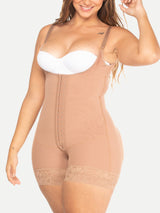
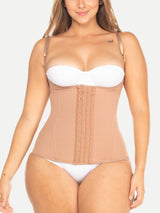
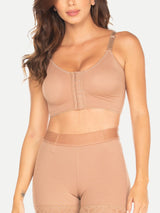








Most patients move into a Stage 3 faja somewhere around week ten to twelve, once the surgeon confirms primary healing is done. The switch is not about more compression for its own sake. It is the point where the garment stops protecting healing tissue and starts shaping a body that has finished healing, and that changes what you should be looking for.
In This Article · 7 min read
If you are still working out how the three stages relate to each other, start with our complete guide to Stage 1, 2 and 3 fajas. This piece assumes you are already in a Stage 2 garment and trying to work out whether it is time to move on.
We have been fitting Colombian fajas in person at our two New Jersey stores since 2012. Your surgeon's clearance always comes first — this is a shopping guide, not medical advice.
What Actually Changes at Stage 3
Three things, and they are worth understanding before you spend money.
- The job changes. Stage 2 is managing residual swelling and helping skin retract while tissue is still remodeling. Stage 3 is working on a stable body: defining the waist, holding the contour you ended up with, and maintaining it.
- The construction changes. Maximum compression, reinforced sculpting panels, and often light boning for structure and posture. These are aggressive garments — which is exactly why they are wrong for a body still in active recovery.
- The features change. Stage 1 and 2 garments are built around surgical practicalities: open crotch, zippers you can reach, hems that clear incisions. Stage 3 drops most of that. You get to think about neckline, straps, color, and whether it disappears under a dress.

When to Switch
Two conditions, and you want both rather than either.
Your surgeon clears you. Usually at the ten to twelve week visit, when they confirm primary healing is complete. Some patients are cleared earlier, some considerably later, and procedures with a muscle repair often run longer.
Your Stage 2 garment feels loose. Not slightly — noticeably. You are on the last hook column and it still does not feel like it is doing much. That looseness means your swelling has resolved and the garment has run out of adjustment.
If only one of the two is true, wait. The calendar is the least reliable signal of the three.

Signs You Are Not Ready Yet
- Your swelling still fluctuates day to day. If you are visibly puffier in the evening than the morning, your body is still moving fluid around.
- Your Stage 2 still tightens meaningfully. If you have hook columns left, use them. That garment is not finished.
- Anything on the incision is still tender. Maximum compression over tissue that still complains is not a shortcut to a better result.
- You had a muscle repair and are inside twelve weeks. Ask specifically. Repairs change the timeline.
Nothing is lost by staying in Stage 2 an extra few weeks. Going too early can be uncomfortable at best and can distort a result you paid for at worst.
Stage 2 vs Stage 3
| Stage 2 | Stage 3 | |
|---|---|---|
| When | Weeks 3 to 12 | Month 3 onward |
| Compression | Medium to high | Maximum |
| Job | Drainage and skin retraction | Contouring and maintenance |
| Construction | Hook columns, smooth panels | Reinforced panels, often boning |
| Surgical features | Open crotch, incision clearance | Usually none needed |
| Wear time | 12 to 16 hrs | As you like |
| Sizing rule | Between sizes, go up | Between sizes, go down |
Buying Stage 3 Without Surgery
Plenty of women buy Stage 3 having never had a procedure, and there is nothing odd about it. The stage number describes compression level and construction, not a medical prescription. If you want firm shaping for daily wear, an event, or waist definition under clothes, this is the tier that delivers it.
Styles like the Ultra-Sculpt Waist Trainer Vest with Hooks NS173 or the Strapless Waist Cincher Corset NS315 sit in this category, and the strapless options are the ones women reach for when the garment has to disappear under a neckline.
One honest caveat: maximum compression takes acclimatizing to. If this is your first high-compression garment, start with a few hours a day rather than a full day, and do not size down hoping to speed anything up.
Sizing Down at Stage 3
Measure your natural waist at its smallest point, your hips at the widest, and your underbust, then compare against the faja size chart for the specific style. Colombian sizing runs differently from US sizing and varies between brands.
Here the rule flips. Through recovery you sized up, because a garment that will not close over swelling compresses nothing. At Stage 3 your measurements are stable, so if you fall between two sizes, take the smaller one for firmer compression. This is the one stage where sizing down is the right instinct rather than the expensive one.
Measure again before you buy. Your Stage 2 size is not a reliable guide to your Stage 3 size — that is the whole point of having waited.

How Long You Keep Wearing It
There is no end date. Some women wear a Stage 3 faja for a few months while the last of the swelling settles and then stop. Others never stop, because it became the thing they wear under work clothes.
If you had lipo, residual swelling in the flanks and back can take up to six months to fully resolve, and firm compression through that window does contribute to how defined the final result looks. After that it is preference, not protocol.
What We See Go Wrong in the Fitting Room
- Switching on the calendar instead of the body. Week twelve is an average, not an instruction.
- Sizing down two sizes. One, if you are between. Not two, and not as a goal.
- Buying Stage 3 during recovery to "have it ready." Your month-three measurements are not predictable from month one.
- Wearing it all day from day one. Build up. Maximum compression is a real adjustment.
- Assuming firmer is always better. A garment so tight it alters how you breathe is not working harder for you.
If you are local to New Jersey, come see us in West New York or Elizabeth and we will measure you properly before you size down. If you are not, the Stage 3 collection is grouped by compression and style so you can shop what suits how you will actually wear it.
Frequently Asked Questions
When should I switch to a Stage 3 faja?
Usually around week ten to twelve, once your surgeon confirms primary healing is complete and your Stage 2 garment feels noticeably loose on its last hook column. You want both signals rather than either one. Procedures involving a muscle repair often run longer, so ask specifically.
What is the difference between a Stage 2 and a Stage 3 faja?
Stage 2 manages residual swelling and supports skin retraction while tissue is still remodeling, using medium to high compression and hook columns for adjustment. Stage 3 works on a stable body with maximum compression, reinforced sculpting panels and often light boning, and drops the surgical features like open crotch and incision clearance.
Can I wear a Stage 3 faja if I never had surgery?
Yes. The stage number describes compression level and construction, not a medical requirement. Many women wear Stage 3 garments for daily shaping, events, or waist definition. If it is your first high-compression garment, build up your wear time gradually rather than starting with a full day.
Should I size down for a Stage 3 faja?
If you fall between two sizes, yes, take the smaller one for firmer compression. This reverses the recovery rule, where you sized up to accommodate swelling. Measure again rather than assuming your Stage 2 size carries over, and do not drop two sizes.
How long do I have to wear a Stage 3 faja?
There is no required end point. If you had liposuction, residual swelling can take up to six months to fully settle and firm compression through that period contributes to the final contour. Beyond that, many women keep wearing one simply because they like how they feel in it.