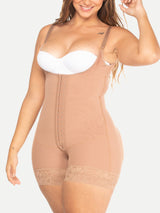
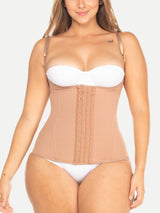
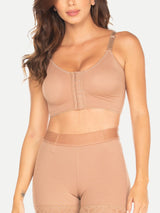







After lipo 360, the faja timeline most surgeons follow is: a Stage 1 garment from day one through about week two or three, a Stage 2 faja from roughly week three to week eight, and a Stage 3 faja from month three onward. The part that trips women up is not the timing. It is that lipo 360 treats your back and flanks too, so a garment that only compresses the front is doing about half the job you paid for.
In This Article · 8 min read
- What "360" Changes About Your Faja
- Weeks 0 to 2: Your First Faja
- Weeks 3 to 8: The Second Faja and the Swelling Rebound
- Month 3 and Beyond: Stage 3
- Lipo 360 Faja Timeline at a Glance
- Foams, Boards, and Why the Back Matters
- If Fat Was Transferred at the Same Time
- How to Size a Faja After Lipo 360
- What We See Go Wrong in the Fitting Room
- Frequently Asked Questions
Lipo 360 is not one procedure with one garment. It is liposuction of your entire midsection — upper and lower abdomen, both flanks, and the lower back — which means the treated area wraps all the way around you. Nothing was cut out and nothing was stitched closed the way it is in a tummy tuck. What you have instead is a full circle of tissue that was disrupted, a lot of fluid with nowhere to go, and a handful of small port incisions.
We have been fitting Colombian fajas in person at our two New Jersey stores since 2012, and lipo 360 patients are the ones most often wearing the wrong shape of garment. Your surgeon's instructions always come first — this is a shopping guide, not medical advice.
What "360" Changes About Your Faja
- Coverage has to wrap. An abdominal binder or a front-focused garment leaves your flanks and lower back uncompressed, and those are treated areas. Uneven compression is how you end up smooth in front and lumpy on the sides.
- Fluid moves. Liposuction leaves behind space where fat used to be, and that space fills with fluid. Compression is what keeps it from pooling in the areas that get the least pressure — which, on most garments, is exactly your lower back.
- The port incisions are small but they matter. They are usually at the flanks, the bikini line, and sometimes above the tailbone. Check that no seam or hook column sits directly on one.
- You can sit. Unless fat was transferred to your glutes, there is no sitting restriction, so you want full coverage over the hips and seat rather than the open-seat styles BBL patients need.
Weeks 0 to 2: Your First Faja
What you want
A Stage 1 faja with light to moderate compression, a front or side zipper, an open crotch, and — the part specific to you — full torso coverage that comes up over the ribs and down past the hips, wrapping the flanks and lower back completely. Mid-thigh or above-the-knee length is standard if your thighs were treated too.
What it is doing
Managing fluid, keeping pressure even across the whole treated circle, and holding your skin against the new contour underneath while it decides where to settle.
Wear time
Usually 22 to 23 hours a day, off only to shower. Most lipo 360 patients do not have drains, but you will leak from the port sites for the first few days, which is normal and is another reason your first garment gets washed constantly.

Weeks 3 to 8: The Second Faja and the Swelling Rebound
Somewhere around week three, a lot of women panic. You looked slimmer at week one than you do now, and it feels like the procedure is undoing itself. It is not. Early flatness is partly the garment and partly the fact that inflammation has not fully arrived yet. The rebound around weeks three to six is normal, and it is the single most common reason someone walks into our store convinced something went wrong.
What you want
A Stage 2 faja with medium to high compression and hook-and-eye closures in multiple columns, so you can tighten inward as the swelling finally recedes instead of rebuying. Look for silicone bands at the hems — a garment that rolls at the waist creates a pressure ridge, and pressure ridges on healing tissue leave marks that can take months to resolve.
A style that works well here
The Post-Surgical Above the Knee Faja with Hooks NS052 is the one we hand lipo 360 patients most often at this stage: it covers the full torso and wraps the flanks and back rather than focusing on the front panel, and the leg length keeps the thighs compressed if they were part of your procedure.
Wear time
Typically 12 to 16 hours a day, tapering as your surgeon allows.

Month 3 and Beyond: Stage 3
Around the ten to twelve week mark, once your surgeon confirms primary healing is complete, a Stage 3 faja takes over. Maximum compression, reinforced sculpting panels, and a garment whose job is finalizing your waist definition rather than protecting healing tissue.
With lipo 360 specifically, this stage runs longer than people expect. Residual swelling in the flanks and back can take six months to fully resolve, and firm compression during that window is part of what determines how defined your waist looks at the end of it.
Lipo 360 Faja Timeline at a Glance
| Weeks 0 to 2 | Weeks 3 to 8 | Month 3+ | |
|---|---|---|---|
| Stage | Stage 1 | Stage 2 | Stage 3 |
| Compression | Light to moderate | Medium to high | Maximum |
| Coverage | Full torso, wraps flanks and back | Full torso, wraps flanks and back | Full torso or waist-focused |
| Closure | Front or side zipper | Hook-and-eye, multiple columns | Hooks or zipper |
| Main job | Fluid control, even pressure | Drainage, skin retraction, swelling rebound | Waist definition |
| Wear time | 22 to 23 hrs | 12 to 16 hrs | As you like |
Foams, Boards, and Why the Back Matters
Many surgeons and post-op massage therapists send patients home with foam sheets, an abdominal board, or both, worn underneath the faja. The logic is simple: compression fabric follows the curves of your body, so it presses hardest on the parts that stick out and barely at all on the parts that dip in. The dips are your lower back and the hollow just above each hip.
Foams even that out. They also help prevent fibrosis — the firm, lumpy areas that can develop where fluid and scar tissue organize unevenly. If your surgeon or your lymphatic massage therapist has told you to wear foams, factor that into your size: you are sizing a garment that has to close over your body plus a layer of foam. This is the single most common reason a faja that should have fit does not.
Whether you need them, and for how long, is your surgical team's call rather than ours.
If Fat Was Transferred at the Same Time
Lipo 360 is very often paired with a BBL, and that changes the garment completely for the first several weeks. Fat transferred to the glutes cannot take direct pressure while it establishes, so you need an open-seat or cut-back style even though the rest of your compression needs are identical. Our BBL-compatible fajas are separated out for this reason.
If nothing was transferred, ignore all of that and take the full-coverage garment. Covering your seat is not just safe, it keeps the hip and upper-thigh contour compressed along with everything else.

How to Size a Faja After Lipo 360
Measure your natural waist at its smallest point, your hips at the widest, and your underbust, then compare against the faja size chart for the specific style. Colombian sizing runs differently from US sizing and varies between brands.
Two rules that save the most returns. Size for this week's body, not month three's — buying small because you are planning ahead gets you a garment that will not close over post-op swelling, and a garment that will not close compresses nothing. And if you wear foams, size for the foams.
Between two sizes in the first six weeks, take the larger. From month three on, in a Stage 3 or daily-wear faja, take the smaller for firmer compression.
What We See Go Wrong in the Fitting Room
- A garment that stops at the waist. Your back was treated. If the faja does not reach it, it is not compressing it.
- Rolling at the top hem. A rolled band becomes a hard ridge pressing into a treated flank. Silicone-lined hems, or a longer garment, fix it.
- Sizing without the foams on. Try the garment the way you will actually wear it.
- Giving up during the week-three rebound. This is when women stop wearing the faja, which is exactly when the compression is doing the most work.
- Only owning one. You are in it nearly all day and it needs washing constantly in the first weeks. Two is the practical minimum.
If you are local to New Jersey, come see us in West New York or Elizabeth and we will measure you and check the coverage across your back in person. If you are not, the post-surgical collection is organized by stage so you can shop the phase you are actually in.
Frequently Asked Questions
Does my faja need to cover my back after lipo 360?
Yes. The 360 in lipo 360 means your flanks and lower back were treated along with your abdomen. A front-focused binder leaves those areas without compression, which is where uneven results and fluid pooling tend to show up. Look for full torso coverage that wraps completely around.
When can I switch to my second faja after lipo 360?
Usually between weeks three and six, once your surgeon clears you. The physical sign is that your Stage 1 garment feels noticeably loose. If it still feels snug, stay in it, regardless of what week it is.
Why does my swelling look worse at week three than it did at week one?
Because inflammation peaks after the initial period, not during it. Early flatness is partly compression and partly swelling that has not fully arrived. The rebound between weeks three and six is expected and it resolves. This is the moment most people wrongly conclude the procedure failed.
Do I need foams or a lipo board under my faja?
That is your surgeon's or your massage therapist's call, not a universal requirement. When they are recommended, the purpose is to distribute pressure evenly across areas the fabric would otherwise skip, particularly the lower back and the hollows above the hips. If you will be wearing them, size your faja with them on.
How long do I have to wear a faja after lipo 360?
Most protocols run eight to twelve weeks: nearly around the clock for the first two to three weeks, then 12 to 16 hours a day through week eight. Many women keep wearing a Stage 3 faja for months beyond that, since residual swelling in the flanks and back can take up to six months to fully settle.