







A mommy makeover almost always needs two garments, not one. Your abdomen wants a post-surgical faja and your chest wants a surgical bra, and the single all-in-one faja with a built-in bra that works beautifully after a standalone tummy tuck is usually the wrong choice here. That is the decision this guide is about.
In This Article · 8 min read
- Why You Need Two Garments
- The Bra Question
- Weeks 0 to 2: What Goes On First
- Weeks 3 to 8: The Garments You Buy
- Month 3 and Beyond
- Mommy Makeover Compression at a Glance
- If Lipo 360 Was Part of Your Procedure
- Sizing Two Areas That Change at Different Speeds
- What We See Go Wrong in the Fitting Room
- Frequently Asked Questions
"Mommy makeover" is not a single operation. It usually means a tummy tuck combined with breast surgery — an augmentation, a lift, a reduction, or some combination — and very often liposuction of the flanks on top. Every one of those has its own compression requirement, and they do not all want the same thing at the same time.
We have been fitting Colombian fajas in person at our two New Jersey stores since 2012, and mommy makeover patients are the ones most likely to arrive holding one garment that is trying to do two jobs. Your surgeon's instructions always come first — this is a shopping guide, not medical advice, and the breast component in particular is one where your surgical team may specify an exact garment.
Why You Need Two Garments
Your abdomen and your chest are on different protocols after this procedure.
- Your abdomen wants firm, even compression. There is a hip-to-hip incision, usually a muscle repair underneath it, and swelling to manage. Compression here is doing real therapeutic work and it gets firmer over the weeks.
- Your chest wants controlled, specific support. After an augmentation, implants need to settle into position, and surgeons often have precise instructions about where support should and should not sit. After a lift or reduction there are incisions on the breast itself. "Firmer is better" is not the rule here — in some cases it is actively wrong.
A faja with an integrated bra applies whatever compression the garment was designed for to both areas at once. That is efficient after a tummy tuck alone. After breast surgery it removes your ability to follow two different sets of instructions.

The Bra Question
Ask your surgeon three things at your pre-op appointment, because the answers determine what you buy:
- Do you want me in a specific surgical bra? Many surgeons do, and some provide it. If yours specifies one, wear that one.
- Front closure or over the head? You will not be able to lift your arms comfortably for a while. Front-closing is standard for this reason.
- Underwire, and when? Almost always no underwire in the early weeks, with a date when it becomes fine.
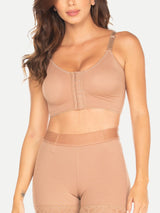
If your surgeon leaves the choice to you after the earliest phase, front-closing post-surgical bras like the Sculpting Bra with Hooks NS027 give you adjustable band tension with wide, non-digging straps and no wire. The point is the adjustability: your chest changes shape as swelling drops, and a band you can loosen or tighten is worth more than one that fits perfectly on day one.
Weeks 0 to 2: What Goes On First
Both garments usually go on before you leave the surgical facility, chosen by your surgical team. On your torso, a Stage 1 faja with light to moderate compression, a front or side zipper rather than a back closure, an open crotch, and hems that clear your incision. On your chest, whatever bra your surgeon specified.
You will likely have drains from the abdominal portion for part of this window, and your first faja needs to accommodate them without the tubing being pinched.
Wear time
Typically 22 to 23 hours a day for both pieces, off only to shower.
Weeks 3 to 8: The Garments You Buy
This is the purchase you make on your own, and it is two purchases.
On your torso
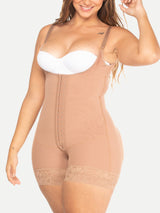
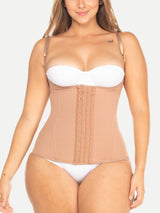
A Stage 2 faja with medium to high compression and hook-and-eye closures in multiple columns, so you can tighten inward as swelling drops instead of rebuying. If you want to keep the two areas independent, a style with a side zipper and adjustable straps like the Sculpting Faja with Side Zipper & Built-In Bra NS053 lets you loosen the upper portion while the abdominal compression stays firm.
On your chest
Whatever your surgeon has cleared you for at this point. Many patients move from the initial surgical bra to a softer front-closing style around this stage. Some are cleared for underwire; many are not until month three.
Wear time
Usually 12 to 16 hours a day on the abdomen, tapering as your surgeon allows. The bra often stays on longer, including overnight, well past when you stop sleeping in the faja.

Month 3 and Beyond
Around the ten to twelve week mark, once your surgeon confirms primary healing is complete, a Stage 3 faja takes over on the torso: maximum compression, reinforced panels, and a job that has shifted from protecting healing tissue to finalizing your waist.
By this point the chest usually needs far less. Most patients are back in normal bras, and the abdominal garment becomes the only thing still doing work.
Mommy Makeover Compression at a Glance
| Weeks 0 to 2 | Weeks 3 to 8 | Month 3+ | |
|---|---|---|---|
| Torso | Stage 1 faja, zipper | Stage 2 faja, hook columns | Stage 3 faja |
| Chest | Surgeon's surgical bra | Front-closing bra, no wire | Usually back to normal bras |
| Torso compression | Light to moderate | Medium to high | Maximum |
| Wear time | 22 to 23 hrs | 12 to 16 hrs | As you like |
| Who chooses | Your surgical team | You, within their limits | You |
If Lipo 360 Was Part of Your Procedure
Very common, and it changes the shape of the torso garment. Lipo 360 treats the flanks and lower back as well as the abdomen, so you need full torso coverage that wraps all the way around rather than a front-focused garment. A binder that stops at the sides leaves treated tissue uncompressed, which is where uneven results tend to show up.
If fat was also transferred to the glutes, you need an open-seat or cut-back style for the first several weeks, which is a different garment again. Our BBL-compatible fajas are separated out for exactly that reason.

Sizing Two Areas That Change at Different Speeds
Measure your natural waist at its smallest point, your hips at the widest, and your underbust, then compare against the faja size chart for the specific style. Colombian sizing runs differently from US sizing and varies between brands.
The complication unique to a mommy makeover is that your abdomen and your chest do not settle on the same schedule. Abdominal swelling drops steadily over the first two months. Breast swelling drops fast in the first weeks and then implants continue settling for months. That is the practical argument for two separate garments rather than one: you can replace or adjust each on its own timeline.
Between two sizes in the first six weeks, take the larger. From month three on, in a Stage 3 or daily-wear faja, take the smaller for firmer compression.
What We See Go Wrong in the Fitting Room
- One garment for both jobs. The single most common mistake, and it usually means the chest gets whatever compression the abdomen needed.
- A bra that goes over the head. You will not be able to raise your arms. Front-closing only, early on.
- Underwire too early. Ask for the date rather than guessing at it.
- Buying the Stage 2 before surgery. Your week-four measurements are not predictable from your pre-op body.
- A front-focused garment when lipo 360 was included. Your back was treated too.
If you are local to New Jersey, come see us in West New York or Elizabeth and we will measure you and check both pieces in person. If you are not, the post-surgical collection is organized by stage so you can shop the phase you are actually in.
Frequently Asked Questions
Do I need a separate bra after a mommy makeover, or is a faja with a built-in bra enough?
In most cases you want them separate. Your abdomen needs firm compression that increases over the weeks, while your chest needs specific support your surgeon has defined, which is often gentler. An all-in-one garment applies one setting to both areas and takes away your ability to follow two different sets of instructions.
How long do I wear compression after a mommy makeover?
The abdominal garment usually runs eight to twelve weeks: nearly around the clock for the first two to three weeks, then 12 to 16 hours a day through week eight, with many patients continuing in a Stage 3 faja beyond that. The bra often continues longer, including overnight, and that timeline comes from your surgeon.
When can I go back to underwire bras?
Usually not in the early weeks, and the specific date is your surgeon's call rather than a general rule. Ask at your pre-op appointment so you can plan what to buy instead of guessing during recovery.
Can I wear a regular faja after a mommy makeover?
Once your surgeon clears you and you are past the early stages, yes. In the first weeks you want a post-surgical style: front or side zipper you can manage without reaching behind you, an open crotch, and hems that clear your tummy tuck incision rather than sitting on it.
What if I had lipo 360 as part of my mommy makeover?
Then your flanks and lower back were treated as well, and your torso garment needs to wrap completely around rather than focusing on the front panel. A garment that stops at the sides leaves treated areas without compression, which is where uneven contours and fluid pooling tend to appear.